
Which Hamster Should I Get? A Guide to Get the Best Hamster for Beginners in Malaysia
- The Hamster Expert

- Jun 2
- 8 min read
Thinking of Getting a Hamster for Yourself or Your Child?
Thinking about getting a hamster for yourself or your child, but not sure where to start?
Don't worry—we've got you covered.
In this guide, we'll cover the four types of pet hamsters commonly found in Malaysia, how to choose a healthy hamster with a good temperament, and the important things to watch out for when shopping for your new furry friend.
Whether you're looking for the best hamster for beginners, a hamster suitable for children, or simply trying to understand the differences between hamster species, this guide will help you make the right choice.
The 4 Types of Pet Hamsters Commonly Found in Malaysia
The four hamster species most commonly found in local pet stores are:
Syrian Hamster
Winter White Dwarf Hamster
Campbell's Dwarf Hamster
Roborovski Hamster
Let's take a closer look at each one.
Syrian Hamsters (Best Choice for Beginners and Families)

Also known as the Golden Hamster or Teddy Bear Hamster, Syrian hamsters come in an incredible variety of colours and coat patterns—seriously, there are so many variations that it's almost crazy.
They are usually friendly, calm and easy to handle. As they grow older, they tend to become even calmer and more tame. Naturally, many Syrian hamsters become quite comfortable with handling by the time they are 4 to 6 months old.
Compared to the other three species, Syrian hamsters move much more slowly, making them easier to handle. With proper training and daily interaction, they can become attached and responsive to their owners within just one or two weeks.
They usually don't nip unless your fingers smell like food or they think you're about to feed them. However, if they feel threatened, they can bite quite hard—and yes, that usually means bleeding.
That's why it's important to learn safe handling techniques and proper ways to hold a hamster. Our hamster specialists are always happy to teach you. Once you've learned the correct techniques and precautions, you'll be absolutely fine handling a Syrian hamster.
Syrian hamsters are the largest of the four species, growing up to about 15cm in length. A healthy adult typically weighs between 100g and 200g.
Because of their size, they require larger cages, wheels and accessories. The details can be found in our free Beginner Hamster Care Guide, available for download on our website.
While the initial setup may cost a little more, Syrian hamsters are definitely the best option for beginners and especially for children.
Best for:
First-time hamster owners
Families with children
Owners who enjoy handling their pets
People looking for a friendly and trainable hamster
Winter White Dwarf Hamsters (Small, Active and Fun to Watch)

Winter White dwarf hamsters are also known as Russian Dwarf Hamsters, Djungarian Hamsters or Siberian Hamsters.
In Malaysia, they are commonly found in colours such as Pearl, Golden, Sapphire and Agouti.
They move much faster than Syrian hamsters but are still manageable for people with reasonably quick reflexes. If your reaction speed is a bit slow, this may not be the hamster for you!
Winter Whites also tend to nip and nibble fingers, hands and clothing. Thankfully, their nips usually feel more like a pinch and rarely cause bleeding.
As they grow older, some may become a little territorial, although personality varies from hamster to hamster.
While some sources claim that dwarf hamsters can be housed together, we generally don't recommend it. Sometimes it works and sometimes it doesn't. The real trouble starts when one hamster decides to become the neighbourhood bully—that's when things get chaotic.
If possible, keep only one hamster per cage.
"But won't the hamster get lonely?"
Yes, that's exactly why you should interact with your hamster daily. Even one minute of positive interaction can make a difference.
Winter White hamsters are also prone to diabetes, so it's important to be careful with treats and monitor how much sugary food they consume.
A healthy Winter White typically weighs around 40g to 60g.
Although they are small, they still require a properly sized cage and running wheel. The setup details can be found in our Beginner Hamster Care Guide.
The initial setup cost is quite manageable because they are smaller animals. However, that does not mean you should use an undersized cage. Small cage equals stress, and stress can lead to health problems, shortened lifespan and increased biting behaviour.
Best for:
Owners with limited space
People who enjoy watching active pets
Owners comfortable with occasional nibbling
Campbell's Hamsters (Cute, Energetic and Slightly More Nippy)

Campbell's hamsters are quite similar to Winter White hamsters, but with one important difference—they are usually a little more nippy.
If you don't enjoy being nibbled on, you may want to stay away from Campbell's hamsters because they seem genetically programmed to find human fingers absolutely fascinating.
In Malaysia, Campbell's hamsters are available in many beautiful coat colours and patterns. If you enjoy unique-looking hamsters, this species offers plenty of variety.
Physically, Campbell's hamsters tend to have slightly longer ears and a more pointed face compared to Winter Whites.
Cute? Absolutely.
The frequency of nipping, however, is generally higher than in Winter Whites. That's simply something to keep in mind.
Of course, there are always exceptions.
We once had a Campbell's hamster come to KL Hamsters Farm for boarding. He belonged to one of our customers and had one of the best personalities we've ever seen. He never nipped, was incredibly calm and behaved like a tiny gentleman throughout his stay.
So while general observations are useful, every hamster is still an individual with its own personality.
Best for:
Owners who appreciate unique coat patterns
People who don't mind occasional nipping
Hamster enthusiasts who enjoy observing different personalities
Roborovski Hamsters (Tiny Speedsters Built for Zoomies)
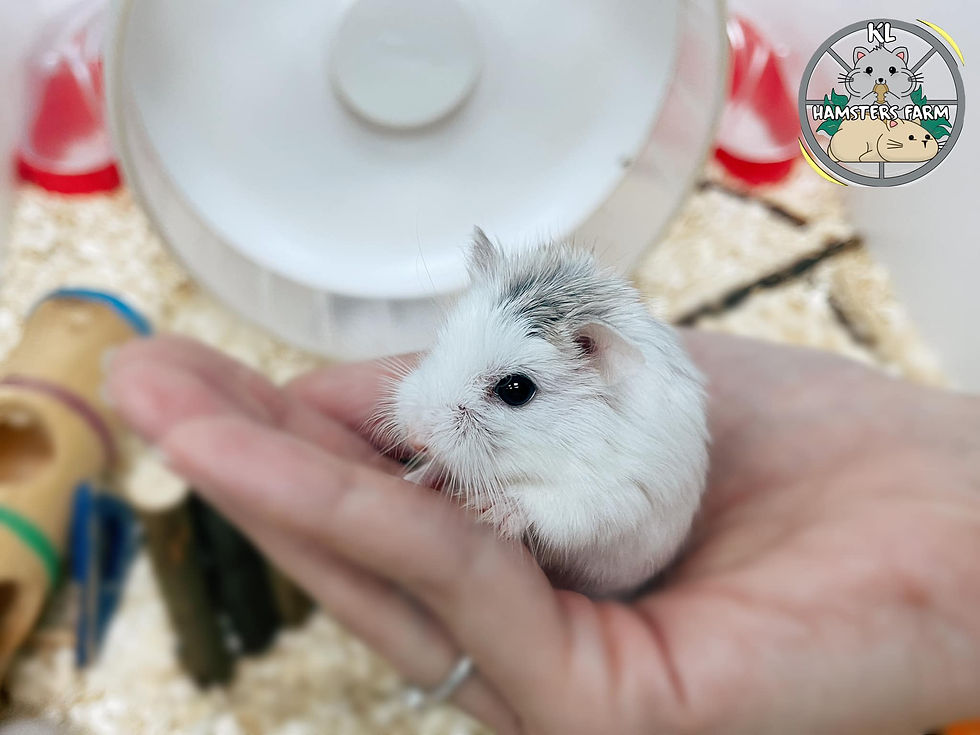
Roborovski hamsters are the smallest and fastest of all hamster species.
They are extremely skittish and very difficult to tame. Building trust with a Roborovski takes a tremendous amount of patience and consistency.
Again, there are always exceptions.
We used to breed Roborovski hamsters, and we successfully trained and tamed a few of them. However, it required a lot of time, effort and consistency.
Our conclusion?
Roborovskis are fantastic for watching, but not ideal for handling.
They are definitely not the best choice for beginners or children who want a hamster they can regularly pet and hold.
One thing they absolutely love is running on their wheel. Watching a Roborovski sprint at full speed is honestly quite entertaining.
The downside?
Many of them also enjoy peeing and pooing while running.
So yes, expect daily wheel-cleaning duties.
Roborovskis usually don't nip because most people can't catch them in the first place.
However, if you somehow manage to forcefully grab one, two things may happen:
The hamster suddenly plays dead.
The hamster reminds you that it's still a hamster by delivering a surprisingly painful needle-like bite.
Don't underestimate them just because they're tiny!
Best for:
Experienced hamster owners
People who enjoy observing rather than handling
Owners who appreciate tiny animals with enormous energy
Which Hamster Is Best for You?
Choose a hamster based on the available space in your home.
A larger Syrian hamster requires a larger cage and bigger accessories.
You should also choose based on how much handling you want to do.
Want a hamster that is generally easier to hold and interact with?
Go for a Syrian hamster.
Prefer a smaller hamster and don't mind the occasional nibble?
A Winter White may be a good choice.
Love unique coat patterns and don't mind a hamster with a little extra attitude?
A Campbell's hamster might suit you perfectly.
Want a tiny speedster that's fun to watch zoom around its enclosure?
Consider a Roborovski.
Every species has its strengths. The best hamster is the one that matches your expectations, lifestyle and personality.
How to Choose a Good Pet Store
Before choosing a hamster, choose the right place to buy it from.
If a pet store smells bad, that's a major warning sign.
Think about it.
If the store smells unpleasant during your short visit, imagine the hamster living in that environment 24 hours a day, every day, since birth. That's a lot of time spent marinating in questionable aromas.
Poor maintenance often means bedding heavily contaminated with urine and droppings, which increases the risk of disease.
This is one reason why some people's hamsters pass away just a few weeks after purchase—the hamster may not have been healthy to begin with.
There is also the risk of infections spreading to humans.
If a store overcrowds many hamsters into a small cage, the animals may fight, become injured, get sick and spread pathogens amongst one another. If that hamster later bites you or your child, that becomes a serious concern.
So before choosing a hamster, choose the right place to shop.
At KL Hamsters Farm, we maintain high standards of hamster care through proper hygiene, spacious housing, regular health monitoring and careful handling practices. Our goal is to ensure that every customer receives a healthy, high-quality hamster.
The fact that customers from countries with very high pet-care standards, such as Sweden, choose to get their hamsters from us tells us we're doing something right.
How to Choose a Healthy Hamster

A healthy hamster should have:
A clean, dry and well-groomed coat
Bright, fully open eyes
A clean nose with no discharge
A clean rear end with no signs of diarrhoea
Active and alert behaviour
A wet hamster is often a sign of illness.
Check the eyes, nose and anus carefully. There should be no watery discharge or signs of wet tail.
Take your time observing the hamster. Healthy hamsters are usually curious, active and responsive to their surroundings.
Can a Hamster Choose Its Owner?
This may sound surprising, but hamsters can sometimes show preferences towards certain people.
We believe that scent and pheromones play a role.
If a hamster dislikes your scent, it may repeatedly move away from you. If it likes your scent, it may voluntarily move towards you and become more comfortable around you.
If a hamster is extremely frightened and refuses to be handled, it may simply not be ready yet. Fortunately, with proper training and patience, this can often be improved over time.
We recommend spending at least 15 to 30 minutes interacting with a hamster before deciding to bring it home.
One of the signs that a hamster is becoming comfortable with you is grooming.
If a hamster grooms itself while sitting on your hand, that's a good sign.
One grooming session could happen by chance.
But two or three grooming sessions on your hand?
That's often a strong indication that the hamster feels safe and comfortable around you.
Take your time.
We don't believe in buying hamsters the same way people buy household products.
A hamster is a pet and a living companion.
That's why we encourage our customers to spend quality time with the hamster before making a decision. Most customers spend between one and two hours at our store interacting with their potential new friend.

We also make sure customers learn proper handling techniques and understand the basics of hamster care before bringing their hamster home.
KL Hamsters Farm is truly a one-stop learning centre for people who want the very best for their pet hamsters.
Download Our Free Beginner Hamster Care Guide
Before buying a hamster, download our free Beginner Hamster Care Guide from our website and read it carefully.
If you'd prefer a physical booklet, feel free to visit our store.
Our walk-in opening hours can be found on Google. Alternatively, send us a WhatsApp message to book an appointment at another time.
One piece of advice: don't start shopping for hamster products online before reading the guide.
Many beginners unknowingly buy unsafe or unsuitable products that end up wasting money—or worse, putting their hamster's health at risk.
Our care guide summarises the most important information you need to avoid common beginner mistakes and provide a safe, happy home for your hamster.
If you have any questions, feel free to send us a message and we'll be happy to help.
We hope you enjoyed reading this guide, and we look forward to helping you find the perfect hamster companion.

Comments